Celsius to Fahrenheit Converter
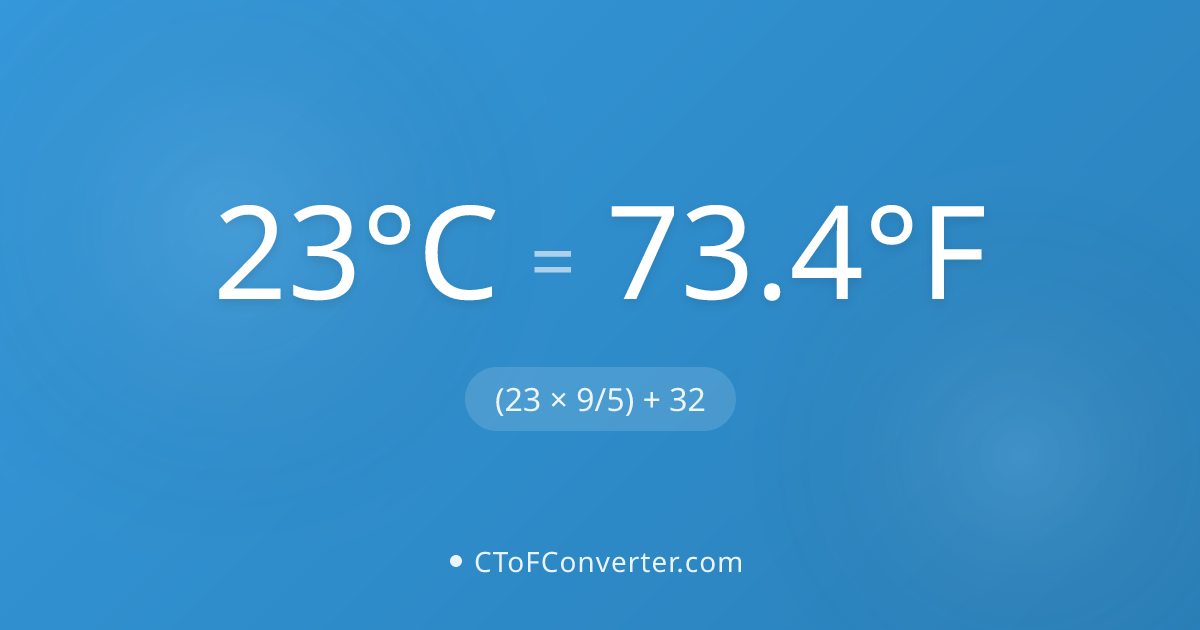
23°C in Fahrenheit is 73.4°F.
How to Convert 23 Celsius to Fahrenheit: Exact Formula
To convert from Celsius to Fahrenheit, use the following formula:
Step-by-Step Calculation
- Step 1: First, multiply your Celsius value (23) by 9/5 (or 1.8).
Calculation: 23 × 1.8 = 41.4 - Step 2: Next, simply add 32 to the result (41.4).
Calculation: 41.4 + 32 = 73.4 - Result: So, 23 degrees Celsius is equal to 73.4 degrees Fahrenheit.
23°C weather and comfort guide
Is 23°C hot or cold?
23°C (73.4°F) usually feels mildly warm. It is still comfortable for indoor spaces, but it starts to feel more summery outdoors, especially in direct sun or high humidity.
Light layers still help
Comfortable indoors and mild outdoors
Summer-like daytime conditions
| Temperature | Description | Typical use |
|---|---|---|
| 20°C (68°F) | Neutral room temperature | Classic indoor comfort point |
| 22°C (71.6°F) | Comfortably warm | Living rooms and office spaces |
| 23°C (73.4°F) | Mild warm comfort | Pleasant indoor climate and mild outdoor weather |
| 26°C (78.8°F) | Warm summer feel | Outdoor dining, open windows, and light clothing |
| 30°C (86°F) | Hot weather | Heat management and hydration become more important |
| 37°C (98.6°F) | Normal body temperature | Body temperature comparison point |
Note: 23°C often feels ideal outdoors when humidity is low. In humid rooms, the same number can feel warmer than expected.
Practical Applications of 23°C (73.4°F)
23°C (73.4°F) represents comfortable weather conditions. Ideal for outdoor activities.
23°C (73.4°F) can be used in various laboratory and scientific processes.
23°C (73.4°F) is suitable for room temperature storage of various products.
Frequently Asked Questions
23°C (73.4°F) is generally considered a comfortable temperature, neither hot nor cold. It's ideal for indoor environments and is often described as "room temperature."
Perception can vary based on:
- Season: 23°C feels warmer in winter than in summer
- Humidity: Higher humidity can make it feel warmer
- Personal preference: Some prefer slightly cooler or warmer temperatures
- Activity level: More active people may prefer cooler temperatures
Negative 23°C (-23°C) equals -9.4°F. This is a very cold temperature typically experienced in:
- Northern regions during winter
- High-altitude locations
- Freezer storage conditions
- Extreme weather events
At -23°C, exposed skin can freeze in minutes, and appropriate winter clothing is essential for safety.
No, 23°C is not a fever temperature. This is a common misunderstanding from temperature conversion searches.
Actual fever temperatures are:
- Normal body temperature: 36.5-37.5°C (97.7-99.5°F)
- Fever: 38°C+ (100.4°F+)
- 23°C would be hypothermia, not fever
23.5°C converts to 74.3°F. The calculation is:
°F = (23.5 × 9/5) + 32 = (42.3) + 32 = 74.3°F
This is still within the comfortable room temperature range, just slightly warmer than 23°C.
23°C is far too low for oven cooking. Standard oven temperatures are much higher:
- Very low oven: 120°C (250°F)
- Moderate oven: 180°C (350°F)
- Hot oven: 220°C (425°F)
23°C is closer to room temperature than cooking temperature. It might be used for proofing bread or slow fermentation but not for actual baking.
Here's a quick mental calculation method:
- Double the Celsius value: 23 × 2 = 46
- Subtract 10%: 46 - 4.6 = 41.4
- Add 32: 41.4 + 32 = 73.4°F
This gives you the exact conversion of 73.4°F.
For more conversion techniques, check our C to F formula guide.
ℹ️ Editorial Note
Weather interpretation and 'feels like' descriptions are based on meteorological indices and public safety advisories regarding heat and cold exposure.
Sources: NOAA, National Weather Service, Met Office.