Celsius to Fahrenheit Converter
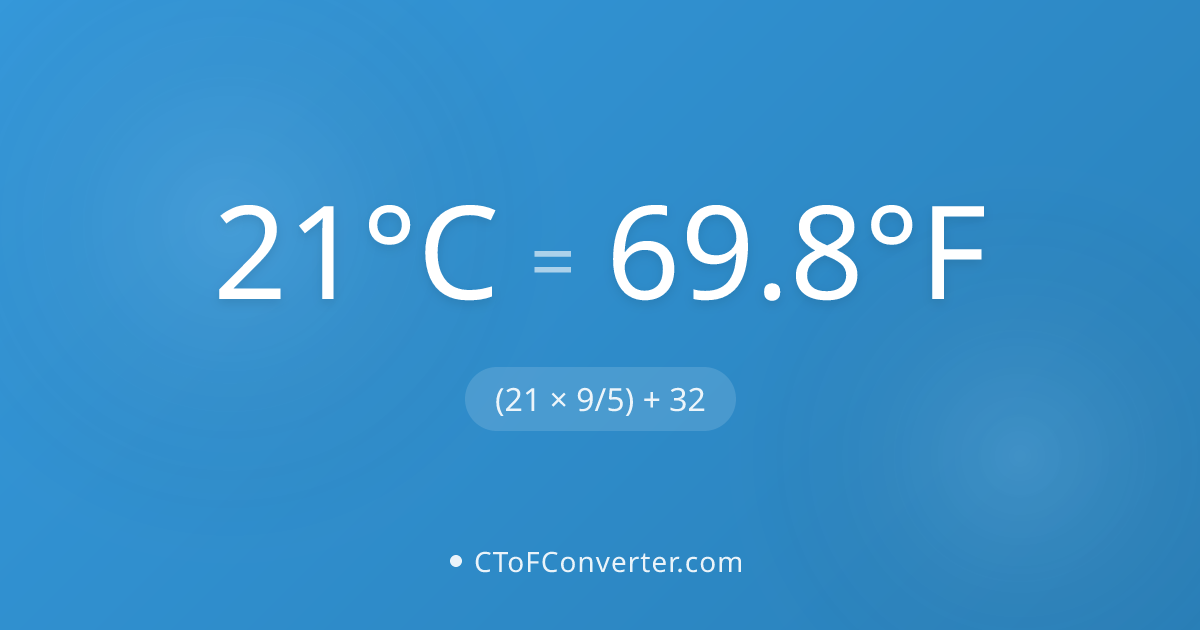
21°C in Fahrenheit is 69.8°F.
How to Convert 21 Celsius to Fahrenheit: Exact Formula
To convert from Celsius to Fahrenheit, use the following formula:
Step-by-Step Calculation
- Step 1: First, multiply your Celsius value (21) by 9/5 (or 1.8).
Calculation: 21 × 1.8 = 37.8 - Step 2: Next, simply add 32 to the result (37.8).
Calculation: 37.8 + 32 = 69.8 - Result: So, 21 degrees Celsius is equal to 69.8 degrees Fahrenheit.
21°C comfort guide
What 21°C feels like indoors and outdoors
21°C (69.8°F) sits in the middle of the comfort range. It is mild for daily life, easy to manage indoors, and usually pleasant for walking, commuting, or office work.
Light jacket weather
Comfortable homes and offices
Light clothing and open windows
| Temperature | Description | Typical use |
|---|---|---|
| 10°C (50°F) | Cool outdoor weather | Spring or autumn conditions with a light jacket |
| 17°C (62.6°F) | Fresh and lightly cool | A good in-between temperature for walking and lighter layers |
| 21°C (69.8°F) | Comfortable room temperature | Balanced indoor comfort for work, reading, and daily routines |
| 25°C (77°F) | Pleasantly warm | Mild summer weather and relaxed outdoor activities |
| 30°C (86°F) | Hot | Warm summer afternoons where shade and hydration matter |
| 37°C (98.6°F) | Normal body temperature | Human body temperature benchmark |
Note: 21°C is often close to a thermostat setting people describe as neutral. Humidity, airflow, and sunlight can still make it feel slightly cooler or warmer.
Practical Applications of 21°C (69.8°F)
21°C (69.8°F) represents comfortable weather conditions. Ideal for outdoor activities.
21°C (69.8°F) can be used in various laboratory and scientific processes.
21°C (69.8°F) is suitable for room temperature storage of various products.
Frequently Asked Questions
21°C (69.8°F) is generally considered a comfortable room temperature - neither hot nor cold. It's the standard temperature recommended for indoor environments in many countries. Most people find this temperature ideal for sedentary activities and can wear normal indoor clothing without feeling either chilly or warm.
In outdoor contexts, 21°C would be described as mild or pleasant - perfect for light outdoor activities without needing heavy clothing.
No, 21°C is not a fever temperature. Normal human body temperature is approximately 37°C (98.6°F). A fever typically begins at 38°C (100.4°F). 21°C is significantly below normal body temperature and would represent a life-threatening hypothermic condition if it were body temperature.
This confusion sometimes arises from misreading thermometers or misunderstanding temperature scales. Always ensure you're reading body temperature measurements correctly.
The temperature range of 18-21°C converts to 64.4-69.8°F. This range represents the energy-efficient comfort zone:
- 18°C = 64.4°F (cool but comfortable with light activity)
- 19°C = 66.2°F (comfortable for active households)
- 20°C = 68°F (standard comfortable temperature)
- 21°C = 69.8°F (ideal for sedentary activities)
Many energy efficiency programs recommend keeping thermostats within this range to balance comfort and energy consumption.
The temperature range of 21-25°C converts to 69.8-77°F. This represents the warm comfort range:
- 21°C = 69.8°F (standard room temperature)
- 22°C = 71.6°F (very comfortable for most people)
- 23°C = 73.4°F (slightly warm for sedentary activities)
- 24°C = 75.2°F (comfortable for those who prefer warmth)
- 25°C = 77°F (warm, may require light clothing)
This range is common in tropical countries or during summer in temperate regions.
To convert -21°C to Fahrenheit, use the same formula: °F = (°C × 9/5) + 32
Calculation: (-21 × 9/5) + 32 = (-37.8) + 32 = -5.8°F
So -21°C equals -5.8°F, which is well below freezing and considered very cold weather.
Indoors at 21°C (69.8°F), most people find a T-shirt comfortable, especially when active. However, individual comfort varies, and some people might prefer a light long-sleeve shirt or sweater, particularly if they're sedentary.
Outdoors at 21°C, whether a T-shirt is comfortable depends on additional factors like wind, sun exposure, and humidity. On a calm, sunny day at 21°C, many people find a T-shirt perfectly comfortable, while on a windy or cloudy day, a light jacket might be preferred.
ℹ️ Editorial Note
Weather interpretation and 'feels like' descriptions are based on meteorological indices and public safety advisories regarding heat and cold exposure.
Sources: NOAA, National Weather Service, Met Office.