175 Degrees Celsius to Fahrenheit Conversion
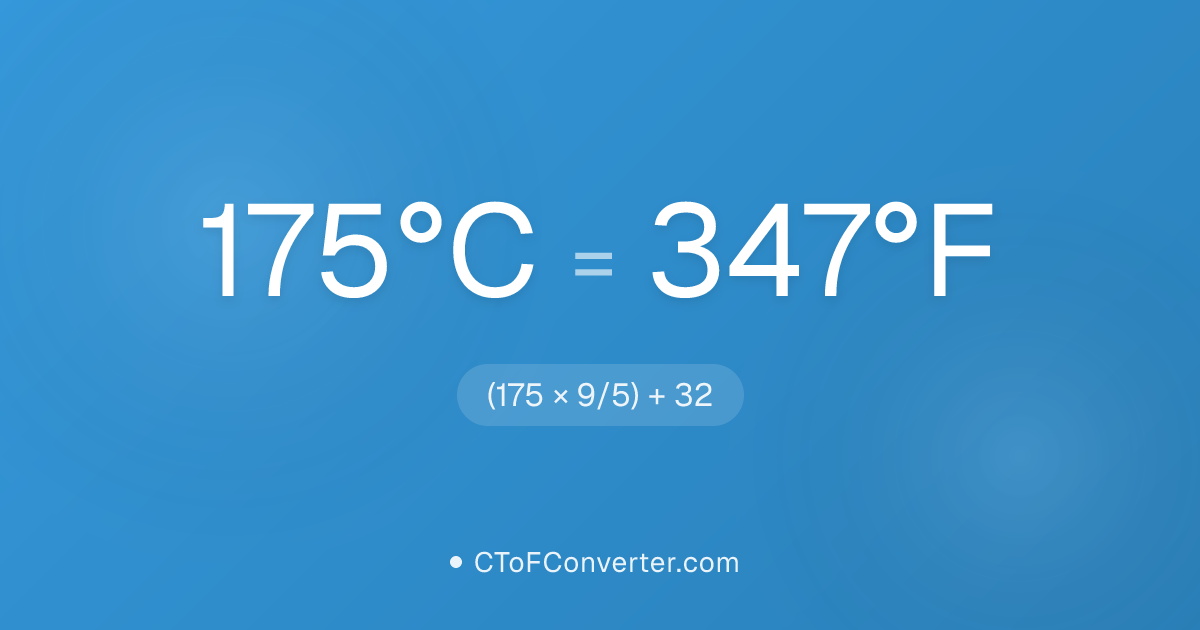
175 degrees Celsius equals 347 degrees Fahrenheit, calculated as (175 × 9/5) + 32 = 347°F. It is a moderate oven temperature loved for gentle, even baking: Victoria sponge, Bakewell tart and slow-roast chicken all turn out beautifully at 175°C. For fan ovens or air fryers, reduce to 155°C (311°F). Note that 175°C is not the same as the American 350°F — see the comparison below.
About 175°C / 347°F: Why Bakers Choose a Gentler Heat
175°C (347°F) sits 20°C below the standard 180°C baking temperature, and that margin changes how bakes behave. It is still well above the 140°C (285°F) threshold where the Maillard reaction begins, so crusts colour and flavours develop — but the gentler heat gives thick sponges and dense batters time to set their structure before the outside finishes. That is why many bakers drop a Victoria sponge or Bakewell tart to 175°C: the top rises evenly instead of doming and cracking, and the centre cooks through without the edges drying out.
Home ovens are often inaccurate: real-world testing shows many run 25–50°F (14–28°C) hotter or cooler than the dial says. An oven set to 175°C might actually be running at 150°C or 200°C, which matters far more at this temperature than the 3°F gap between 175°C and 350°F. A $10–20 oven thermometer is the single most effective tool for consistent results — place it on the middle rack while preheating and cook to the measured temperature, not the dial.
If you are switching between conventional, convection, fan, or air fryer settings, compare them on the fan oven conversion chart. In most cases, 175°C in a conventional oven equals 155°C in a fan oven or air fryer, with cooking time reduced by 10–15%.
Practical Applications of 175°C (347°F)
British Bakes at 175°C
- Victoria sponge: a gentle 175°C gives an even rise and flat top, ideal for stacking and filling.
- Bakewell tart and millionaire's shortbread: the lower heat sets the filling and caramel without over-browning the base.
- Gingerbread, flapjacks and traybakes: slow, even caramelisation of sugar and syrup without burnt edges.
Slow Roasting and Savoury Cooking
- Slow-roast chicken: 175°C for 20 minutes per 450g plus 20 minutes keeps the breast juicy while the legs turn tender.
- Root vegetables and roast potatoes: 45–60 minutes renders the fat slowly for a crispy outside and fluffy inside.
- Casseroles, braises and baked pasta: thorough, even heating for dishes that cook for an hour or more.
Delicate and Precision Tasks
- Toasting nuts and seeds: 10–15 minutes at 175°C develops flavour without scorching — check every 5 minutes.
- Drying herbs and fleur de sel: a low fan setting at 150–175°C removes moisture while preserving colour.
- Reheating roast dinners and pies: restores crispness at 175°C without drying the filling.
Oven Temperature Guide: Conventional, Fan, Air Fryer & Gas Mark
| Oven Type | Adjusted Temperature | Best Use |
|---|
| Conventional oven | 175°C / 347°F | Moderate baking and roasting: sponges, tarts, slow-roasted meats and casseroles. |
| Fan oven (convection) | 155°C / 311°F | Lower by 20°C because fan circulation cooks faster and more evenly; reduce time by 10–15%. |
| Air fryer | 155°C / 311°F | Preheat fully, use a single layer, and shake the basket halfway — great for reheating and small bakes. |
| Gas Mark | Between 3 and 4 — use 4 | Gas Mark 4 officially equals 180°C (350°F), but 175°C is close enough that recipes round to it. |
For a side-by-side reference of conventional, fan and air fryer settings, see the
fan oven conversion chart. Remember that 350°F in American recipes converts to 177°C, not 175°C.
Baking Times at 175°C (347°F)
Typical times for popular British bakes at 175°C in a conventional oven. Always check doneness with a skewer or thermometer rather than relying on time alone, and rotate the tin once halfway through for even colour.
| Food | Time at 175°C | Doneness Cue |
|---|
| Victoria sponge (two 20cm tins) | 25–30 min | Skewer clean, top springs back, edges just leaving the tin |
| Bakewell tart | 30–35 min | Pastry golden, filling set with a slight wobble |
| Millionaire's shortbread | 35–45 min | Base firm, caramel bubbly, chocolate glossy and set |
| Gingerbread slab | 40–50 min | Springy to the touch, cracked surface, skewer with few crumbs |
| Flapjacks / traybake | 25–30 min | Golden edges, centre still slightly soft — firms on cooling |
| Slow-roast chicken (1.5 kg) | 80–90 min | Internal temp 74°C / 165°F (USDA) in the thickest part |
| Roast potatoes | 45–60 min | Deep golden, crisp outside, fluffy inside |
| Toasted nuts or seeds | 10–15 min | Even golden colour, nutty smell — check every 5 minutes |
Times assume a conventional oven. For fan ovens or air fryers, reduce the time by 10–15% and check doneness early.
USDA Safe Internal Temperatures
Oven temperature is not the same as food internal temperature. A slow roast at 175°C is gentle on meat, which makes a thermometer essential — the USDA recommends these minimum internal temperatures, measured in the thickest part of the food.
| Food Type | Safe Internal Temp (°F) | Safe Internal Temp (°C) |
|---|
| Poultry (whole, ground, stuffing) | 165°F | 74°C |
| Ground meats (beef, pork, lamb) | 160°F | 71°C |
| Whole cuts (steaks, roasts, chops) | 145°F + 3 min rest | 63°C + 3 min rest |
| Fish and shellfish | 145°F | 63°C |
| Egg dishes | 160°F | 71°C |
| Casseroles and leftovers | 165°F | 74°C |
Source: USDA FoodSafety.gov (last reviewed November 2024). Rest meat for 3 minutes after cooking; always verify with a food thermometer.
What NOT to Bake at 175°C
175°C is a gentle all-rounder, but several foods need either higher heat for structure or lower heat for delicate textures. Using 175°C for these leads to soggy bases, pale crusts or cracked custards.
- Meringues, pavlova and macarons — Use 100–150°C — 175°C browns and cracks the delicate structure before it dries out.
- Puff pastry and rough puff — Use 190–200°C — needs high heat for steam to separate the layers.
- Crusty bread and sourdough — Use 200–220°C — needs high heat for oven spring and a blistered crust.
- Pizza — Use 220°C or above — a 175°C base stays pale and doughy.
- Crème brûlée and custards — Use 150–160°C in a water bath — 175°C scrambles the eggs and curdles the custard.
- Scones — Use 220°C — scones need a hot oven for the fast rise that creates their signature layers.
Baking Troubleshooting at 175°C
If your bakes at 175°C are not turning out right, the problem is usually oven accuracy, rack position or tin choice. These are the most common issues at this temperature and how to fix them.
| Problem | Likely Cause | Fix |
|---|
| Cake domes and cracks | Oven runs hotter than the dial, or batter overfilled | Verify with an oven thermometer; if the oven is accurate, drop to 165°C and fill tins no more than two-thirds full. |
| Burnt outside, raw centre | Oven runs hot, or tin too close to the element | Move the rack to the centre, lower to 165°C, and extend the time rather than raising the heat. |
| Pale, dense bake | Oven runs cool, or the door was opened too early | Raise to 180°C and keep the door shut for the first 20 minutes — 175°C is unforgiving of cool ovens. |
| Soggy shortbread or pastry base | Filling too wet, or base under-baked before filling was added | Blind bake the base for 10–12 minutes first, and use a thick jam layer rather than a thin, runny one. |
| Slow-roast chicken is dry | Cooked too long at too high a temperature for the size of the bird | Cover the breast with foil for the first hour and pull the bird at 74°C internal — it will rise 2–3°C while resting. |
| Roast potatoes are pale and soft | Fat not hot enough, or the oven is crowded | Use one tray per batch, render at 175°C for 45 minutes, then blast at 220°C for 10 minutes to crisp. |
| Gingerbread or flapjacks feel doughy | Underbaked in the middle, or too much syrup for the dry ingredients | Give it another 8–10 minutes and test the centre with a skewer — a few moist crumbs mean done; wet batter means more time. |
Frequently Asked Questions
What is 175 degrees Celsius in Fahrenheit?
175 degrees Celsius equals 347 degrees Fahrenheit. The conversion formula is °F = (°C × 9/5) + 32, so multiply 175 by 1.8 to get 315, then add 32 for 347°F. This is a moderate oven temperature that suits gentle baking, slow roasting and anything that needs even, thorough heat.
Is 175°C the same as 350°F?
No. 175°C equals 347°F, while 350°F converts to 176.7°C — a difference of about 3°F (2°C). For most bakes the gap does not matter, but for delicate sponges it is worth using the exact Celsius figure rather than rounding up to 350°F, because the slightly hotter oven can dome and crack a thick batter.
What is 175°C in a fan oven or air fryer?
Reduce by 20°C to 155°C (311°F). Fan circulation cooks roughly 20% faster, so also cut the cooking time by 10–15%. In an air fryer, preheat fully, cook in a single layer, and shake the basket halfway through so food browns evenly without the edges drying out.
What Gas Mark is 175°C?
175°C falls between Gas Mark 3 (170°C) and Gas Mark 4 (180°C). In practice, recipes round 175°C up to Gas Mark 4, which officially equals 180°C (350°F) — close enough for cakes, tarts and roasts. On older gas ovens without precise markings, Gas Mark 4 checked with an oven thermometer is the safest setting.
What can I bake at 175°C?
175°C is ideal for Victoria sponge, Bakewell tart, millionaire's shortbread, gingerbread and flapjacks, plus slow-roast chicken and root vegetables. It suits any bake that benefits from gentle, even heat rather than a fast rise — thick batters set through without doming, and slow roasts stay juicy while their edges caramelise.
ℹ️ Editorial Note
Culinary temperature guidelines for food safety and baking precision are referenced from food safety authorities and professional culinary standards.
Sources: USDA Food Safety and Inspection Service, FDA.