Baking and Pastries
- Useful for sponge cakes and loaf cakes that need even rise and gentle color.
- Works well for biscuits, cookies, and tray bakes that can dry out at higher heat.
- Helps pastries cook through without over-browning the edges too early.
Free online temperature conversion tool that instantly converts 160 degrees Celsius (160°C) to degrees Fahrenheit (°F), with conversion formulas and detailed steps.
160 degrees Celsius equals 320 degrees Fahrenheit. This temperature conversion is commonly used in cooking and baking. Use our Fan Oven to Conventional Oven Conversion Chart for precise settings.
To convert from Celsius to Fahrenheit, use the following formula:
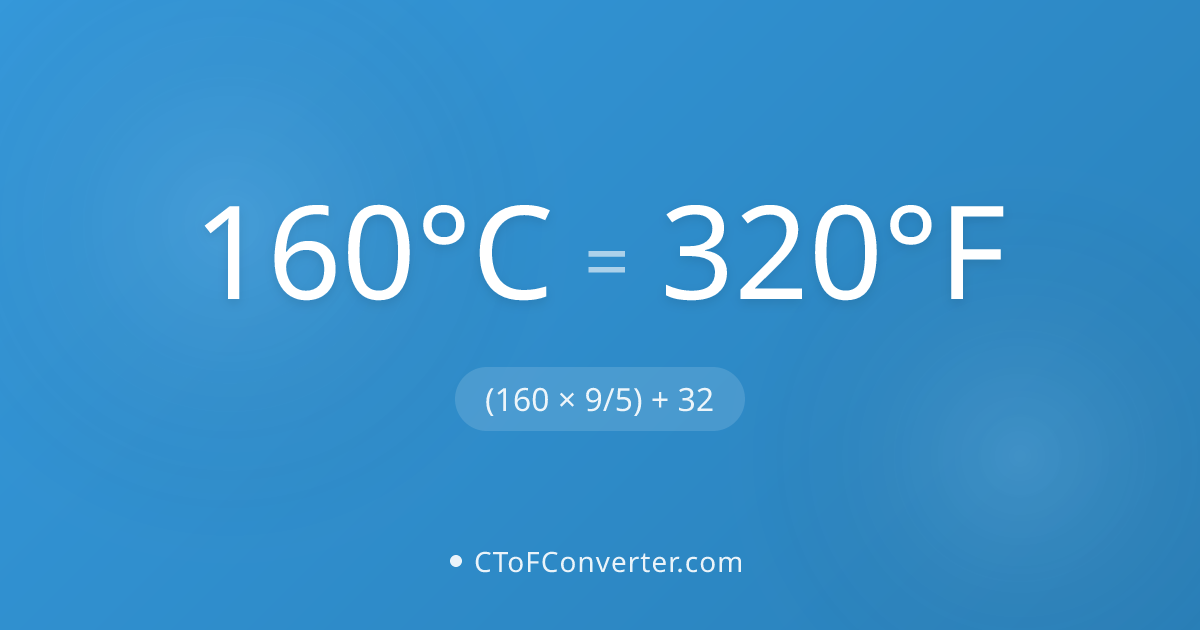
160°C equals 320°F. It is 60 degrees above the boiling point of water, but in everyday cooking it is usually treated as a moderate oven temperature rather than an extreme one.
This is the kind of heat used when you want food to bake or roast evenly without the outside browning too quickly. That is why 160°C appears so often in recipes for sponge cakes, cookies, pastries, tray bakes, and gentle roasting.
The number can also appear in controlled industrial or laboratory settings, but the main search intent behind this page is oven conversion. If your recipe uses a fan or fan-forced oven, the adjusted setting is usually lower than the conventional oven temperature.
| Oven Type | Adjusted Temperature | Best Use |
|---|---|---|
| Conventional oven | 160°C / 320°F | Standard baking temperature for cakes, cookies, and steady roasting. |
| Fan oven (convection) | 140°C / 285°F | Lower setting because circulating air cooks food faster and more evenly. |
| Fan-forced oven | 140°C / 285°F | Common AU/UK term for fan-assisted baking and roasting. |
| Gas Mark | About Gas Mark 3 | Useful when older recipes do not list Celsius or Fahrenheit. |
Culinary temperature guidelines for food safety and baking precision are referenced from food safety authorities and professional culinary standards.
Sources: USDA Food Safety and Inspection Service, FDA.