Baking and Cakes
- The default temperature for sponge cakes, cupcakes, muffins, and tray bakes.
- Produces golden edges and a cooked center for cookies and biscuits.
- Works for banana bread, pound cake, and most quick breads.
Convert 180°C to Fahrenheit, find fan oven and air fryer equivalents, baking times, and USDA safe internal temperatures.
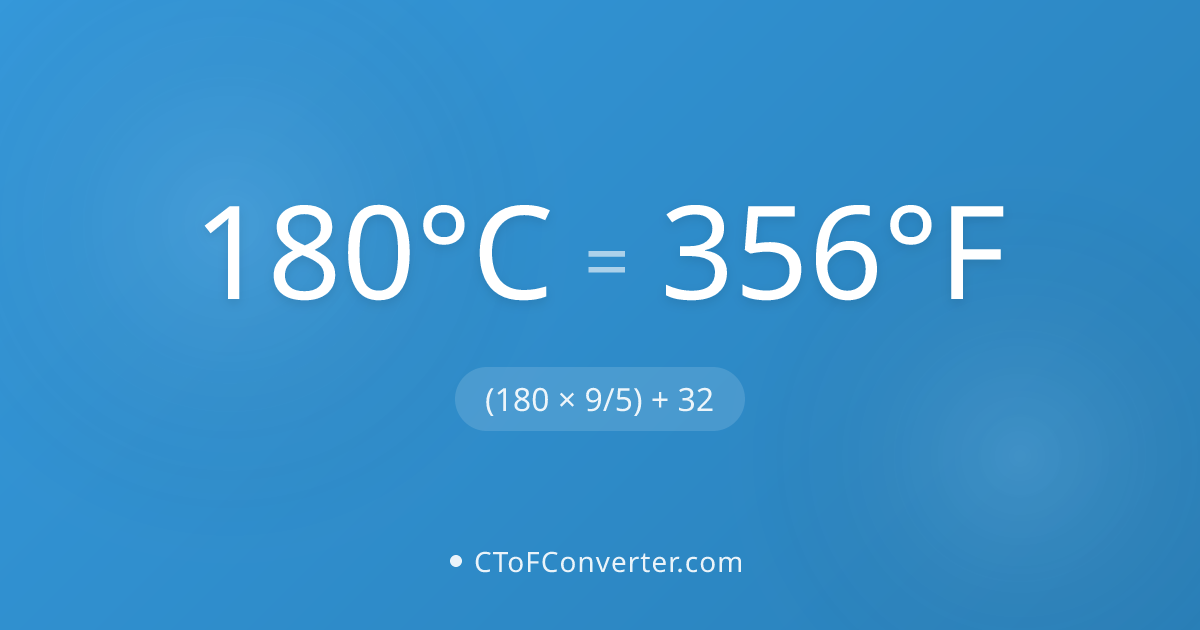
180 degrees Celsius equals 356 degrees Fahrenheit, calculated as (180 × 9/5) + 32 = 356°F. This is the most common conventional oven temperature for baking cakes, cookies, and roasting vegetables. For fan ovens or air fryers, reduce to 160°C (320°F). In Gas Mark terms, 180°C corresponds to Gas Mark 4.
To convert from Celsius to Fahrenheit, use the following formula:
180°C (356°F) is the standard baking temperature because it triggers the Maillard reaction (starting around 140°C / 285°F and peaking near 165°C / 330°F) while staying below the burning point of most sugars (approximately 180°C for sucrose). This means food browns and develops flavor without scorching. At 180°C, most cake batters set their protein structure within 25–35 minutes, long enough for the center to cook through but fast enough to avoid over-browning.
Home ovens are often inaccurate: real-world testing shows many run 25–50°F (14–28°C) hotter or cooler than the set temperature. An oven set to 180°C might actually be 155°C or 205°C. A $10–20 oven thermometer is the single most effective tool for consistent baking results.
If you are switching between conventional, convection, fan, or air fryer settings, compare them with the fan oven conversion chart. In most cases, 180°C in a conventional oven equals 160°C in a fan oven or air fryer.
| Oven Type | Adjusted Temperature | Best Use |
|---|---|---|
| Conventional oven | 180°C / 356°F | Standard baking and roasting for cakes, cookies, and family meals. |
| Fan oven (convection) | 160°C / 320°F | Lower by 20°C because fan circulation cooks faster and more evenly. |
| Air fryer | 160°C / 320°F | Good starting point for crispy foods and smaller portions. |
| Gas Mark | Gas Mark 4 | For older recipes that list gas settings instead of Celsius or Fahrenheit. |
These are typical baking times at 180°C in a conventional oven. Always check doneness with a toothpick or thermometer rather than relying on time alone.
| Food | Time at 180°C | Doneness Cue |
|---|---|---|
| Sponge cake (20cm round) | 25–30 min | Skewer comes out clean, top springs back |
| Brownies (20cm square) | 22–28 min | Slight wobble in center, edges pulling away |
| Muffins (standard size) | 18–22 min | Golden top, skewer comes out clean |
| Cookies (drop cookies) | 10–15 min | Golden edges, centers still soft |
| Banana bread (900g loaf) | 50–60 min | Skewer comes out clean, cracked top |
| Roast chicken (1.5 kg) | 80–90 min | Internal temp 74°C / 165°F (USDA) |
| Roast vegetables | 30–40 min | Caramelized edges, fork-tender |
| Lasagna / casseroles | 30–40 min | Bubbling edges, golden top |
Oven temperature is not the same as food internal temperature. The USDA recommends these minimum internal temperatures to ensure food is safe to eat, measured with a food thermometer inserted into the thickest part.
| Food Type | Safe Internal Temp (°F) | Safe Internal Temp (°C) |
|---|---|---|
| Poultry (whole, ground, stuffing) | 165°F | 74°C |
| Ground meats (beef, pork, lamb) | 160°F | 71°C |
| Whole cuts (steaks, roasts, chops) | 145°F + 3 min rest | 63°C + 3 min rest |
| Fish and shellfish | 145°F | 63°C |
| Egg dishes | 160°F | 71°C |
| Casseroles and leftovers | 165°F | 74°C |
180°C is versatile, but some foods require a different temperature for proper results. Using the wrong temperature leads to cracked surfaces, burnt edges, or undercooked centers.
If your bakes at 180°C are not turning out right, the problem is often oven accuracy, rack position, or pan choice. Here are the most common issues and how to fix them.
| Problem | Likely Cause | Fix |
|---|---|---|
| Burnt outside, raw inside | Oven runs hot, or food too close to heat source | Lower to 170°C, move rack to center, use an oven thermometer to verify. |
| Cake sinks in the middle | Underbaked, or too much leavening agent | Extend baking time by 5–10 min, reduce baking powder by 1/4 tsp. |
| Pale, dense bake | Oven runs cool, or oven door opened too early | Raise to 190°C, avoid opening the door before 20 minutes. |
| Bottom burns before top browns | Dark pan absorbs more heat, or rack too low | Move rack up one position, double-pan, or use a lighter-colored pan. |
| Cakes crack on top | Oven too hot, or batter overfilled | Reduce to 170°C, fill pans no more than 2/3 full. |
Culinary temperature guidelines for food safety and baking precision are referenced from food safety authorities and professional culinary standards.
Sources: USDA Food Safety and Inspection Service, FDA.