Celsius to Fahrenheit Converter
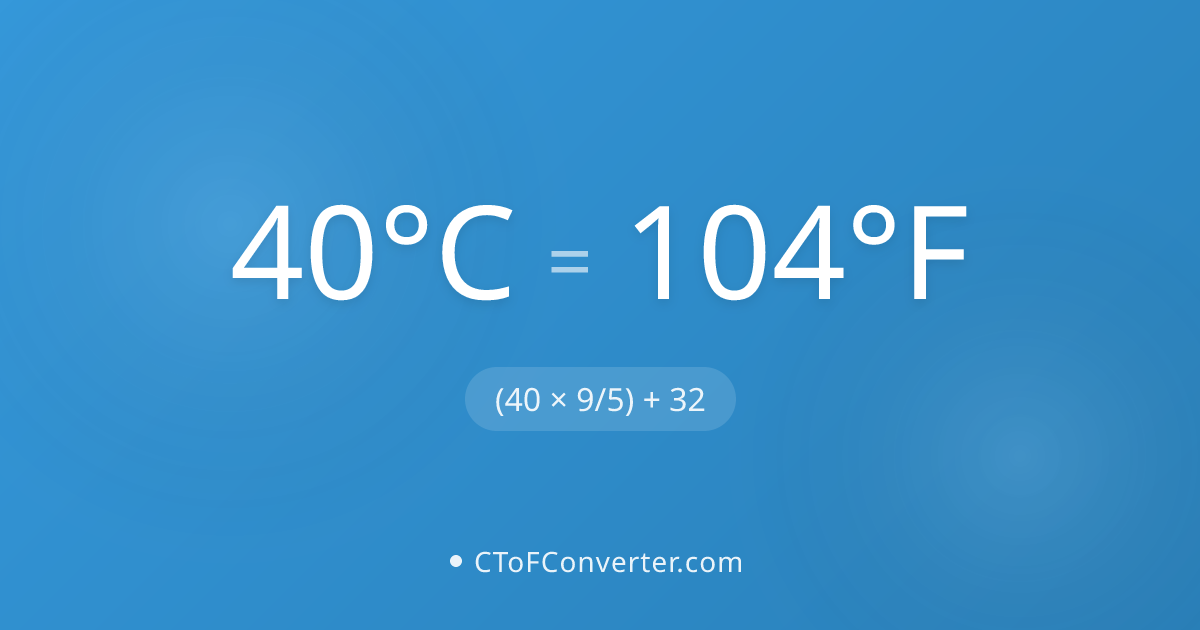
40 degrees Celsius equals 104 degrees Fahrenheit. This temperature conversion is commonly used in body temperature measurements. Consult our comprehensive Body Temperature Chart & Fever Guide for accurate diagnostics.
How to Convert 40 Celsius to Fahrenheit: Exact Formula
To convert from Celsius to Fahrenheit, use the following formula:
Step-by-Step Calculation
- Step 1: First, multiply your Celsius value (40) by 9/5 (or 1.8).
Calculation: 40 × 1.8 = 72 - Step 2: Next, simply add 32 to the result (72).
Calculation: 72 + 32 = 104 - Result: So, 40 degrees Celsius is equal to 104 degrees Fahrenheit.
Fever Alert: 40°C (104°F)
Is 40°C a High Fever?
Yes, 40°C (104°F) is considered a high fever for both adults and children. This temperature indicates a significant immune response or serious infection and requires immediate medical evaluation, especially if accompanied by severe symptoms.
36.1-37.2°C
38-39°C
40°C +
| Condition | Celsius (°C) | Fahrenheit (°F) |
|---|---|---|
| Healthy Range | 36.1 - 37.2°C | 97.0 - 99.0°F |
| Low-grade Fever | 37.3 - 37.9°C | 99.1 - 100.3°F |
| Moderate Fever | 38.0 - 39.9°C | 100.4 - 103.8°F |
| High Fever (40°C) | 40.0°C + | 104.0°F + |
Practical Applications of 40°C (104°F)
40°C (104°F) represents hot weather conditions. Stay hydrated and seek shade.
40°C (104°F) is a high fever. Consult a healthcare provider if symptoms persist.
40°C (104°F) can be used in various laboratory and scientific processes.
Frequently Asked Questions
Yes, 40°C (104°F) is a high fever for adults. While a fever itself is a defense mechanism, a temperature this high can be dangerous if it persists or is accompanied by confusion, severe headache, or difficulty breathing.
Yes, 40°C is a very high fever for a toddler. You should seek urgent medical advice from a pediatrician. High fevers in young children can sometimes lead to febrile seizures, though these are usually not permanent.
- Seek emergency care if child is lethargic
- Monitor for vomiting or stiff neck
- Keep the child hydrated and cool
In household laundry, 40°C (104°F) is a standard 'warm' wash setting. It is the most common temperature for washing everyday colored clothes, cottons, and synthetics as it effectively removes soil without excessive energy use or fabric damage.
ℹ️ Editorial Note
Medical temperature data is reviewed against clinical guidelines. Fever thresholds and body temperature interpretations align with standards from major health organizations. Content is compiled based on publicly available clinical guidelines.
Sources: World Health Organization (WHO), CDC, Medical Literature.